
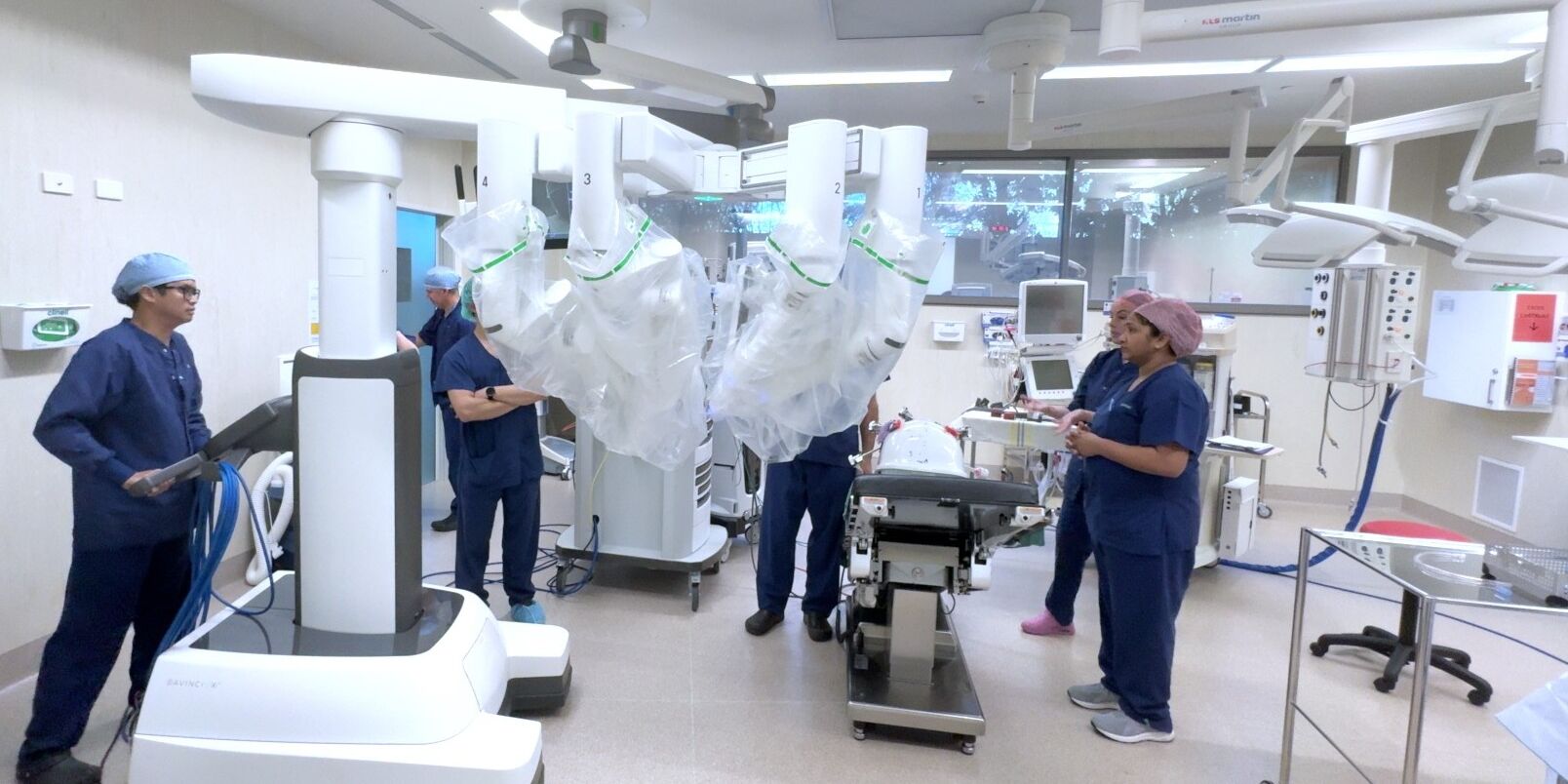
When Samantha Akhtar walked into Braemar Hospital for her surgery last week, she became part of medical history. The kindergarten head teacher didn’t just receive life-changing treatment that morning – she became the first person in the Waikato to undergo robotic surgery using the da Vinci robot.
“That sounds cool,” was Samantha’s immediate response when surgeon Dr Tarek Saleh told her a robot would be performing her hysterectomy. It was a refreshingly relaxed reaction to what would become a watershed moment for healthcare in the region.
A Long Journey to Relief
For Samantha, the surgery represented far more than a medical milestone. After 18 months of living with severe pain, countless painkillers, and one ovary attached to her uterus, she had been pushing through each day for her two children and her work at the kindergarten.
“My symptoms before this surgery – let’s just say it was not very pleasant what was happening in my body,” she explains. “I needed to be active, my brain engaged. I really had to push through a lot to get to this date for surgery.”
The wait to see a surgeon had stretched over a year. When she was finally referred by her GP to the Braemar Charitable Trust’s community surgery programme, which provides free surgery to eligible patients, it felt like magic.
A Team That Cares
What struck Samantha most wasn’t just the cutting-edge technology – it was the people. From the moment she arrived, charge nurse Sonia, anaesthetist Rob, and Dr Saleh made her feel supported and informed.
“As soon as I was in the room, I had the conversation: how are you feeling, what do you need?” Samantha recalls. “Everyone in Braemar is definitely in all of the right places for what they do – they were all amazing.”
When she was wheeled into theatre, with observers there to learn from this historic procedure, Sonia and Rob held her hand. The 2.5 to 3-hour surgery went smoothly, and afterwards, the team even showed her pictures of what the robot had been doing inside her body.
“They read the room and they all have great personalities,” she says warmly.
A Surgeon’s Pride
For Dr Tarek Saleh, performing the Waikato’s first robotic surgery was both an honour and a relief. Patients in Auckland, Christchurch, Wellington, and Tauranga already had access to this technology.
“We’re late to the party, but we’re here now,” he says with characteristic honesty.
The benefits for patients like Samantha are significant. The precision of the robot means quicker recovery times, less post-operative pain, and reduced risk of complications like haematomas and infections. The minimally invasive approach uses smaller incisions, resulting in less scarring and tissue trauma.
But how does it actually work? Surgeons control the robot from a special console, using hand movements that are translated into precise movements of tiny surgical instruments. The 3D camera gives them a magnified view that’s clearer than the human eye can see – incredible technology in the hands of skilled surgical teams.
When Dr Saleh explained the procedure to Samantha, she was initially surprised – “oh really” – but then became excited about being the first. He walked her through the differences from traditional laparoscopic surgery, explaining the potential for quicker recovery and less blood loss.
“I feel really lucky being the first surgeon to do robotics in the Waikato,” Dr Saleh reflects. “It will be wonderful to see many more surgeons follow, and the Waikato will finally be a robotic surgery region.”
Looking Forward
The response has been immediate. Dr Saleh is already fielding calls from patients asking if their surgeries can be done robotically, and he has a busy week of robotic procedures ahead.
For Samantha, the recovery is intense but manageable – and worth it. She hunts, rides motorbikes, and can’t wait to return to the active life she loves.
“This surgery has given me the freedom to be me again – and that is really huge,” she says. “I would say to anyone contemplating or being advised to have robotic surgery: just do it. It was really awesome to be part of.
“The people doing these surgeries – they are experts, they really are.”
Her advice is heartfelt: “A big thanks to every single person who made this experience exceptionally good. It’s not like you are just a patient getting robot surgery. Everyone is so attentive to exactly what you need and where you’re going.”
A New Chapter for Waikato Healthcare
Braemar Hospital plans to have a robotic theatre running four days a week in the near future , with more surgeons currently being robotically trained in gynaecology, urology, and general surgery specialties.
Pru Sheahan, Braemar Hospital’s General Manager Clinical Services emphasises the significance: “Robotic surgery is perfect for the many types of procedures we perform on a weekly basis at Braemar. We are extremely proud to have this now as an offering for our Waikato patients, it gives patients more options.”
She adds special praise for the team who made this milestone possible: “We are incredibly proud of our first robotic team at Braemar Hospital for reaching this historic milestone. Their dedication and skill have been remarkable.”
Dr Saleh echoes this sentiment, highlighting the collaborative effort behind the success: “Braemar has done really well with its robotic team it has trained and developed. The initiation with the robotic team over the last few months has gone fantastically well, and if we can get to train more nurses, I think we will be in even higher demand.”
Thanks also to the Braemar Charitable Trust which offers surgery for patients who have been declined or face a long wait time (as Sam did) in the public system, don’t have private or work-subsidised health insurance or ACC cover, or have access to funds to pay for the procedure privately. The Trust works in partnership with many surgeons and anaesthetists who generously give their time and skill in enabling surgeries for free, including Dr Tarek and Rob Martynoga.
As Samantha prepares to return to her life – to her partner and children, her kindergarten, and the activities she loves – she carries with her not just the benefits of advanced medical technology, but the memory of a team who truly cares. And the Waikato carries forward into a new era of surgical excellence, one patient at a time.
Braemar Hospital is 100% owned by the Braemar Charitable Trust which works to improve healthcare access in the community.