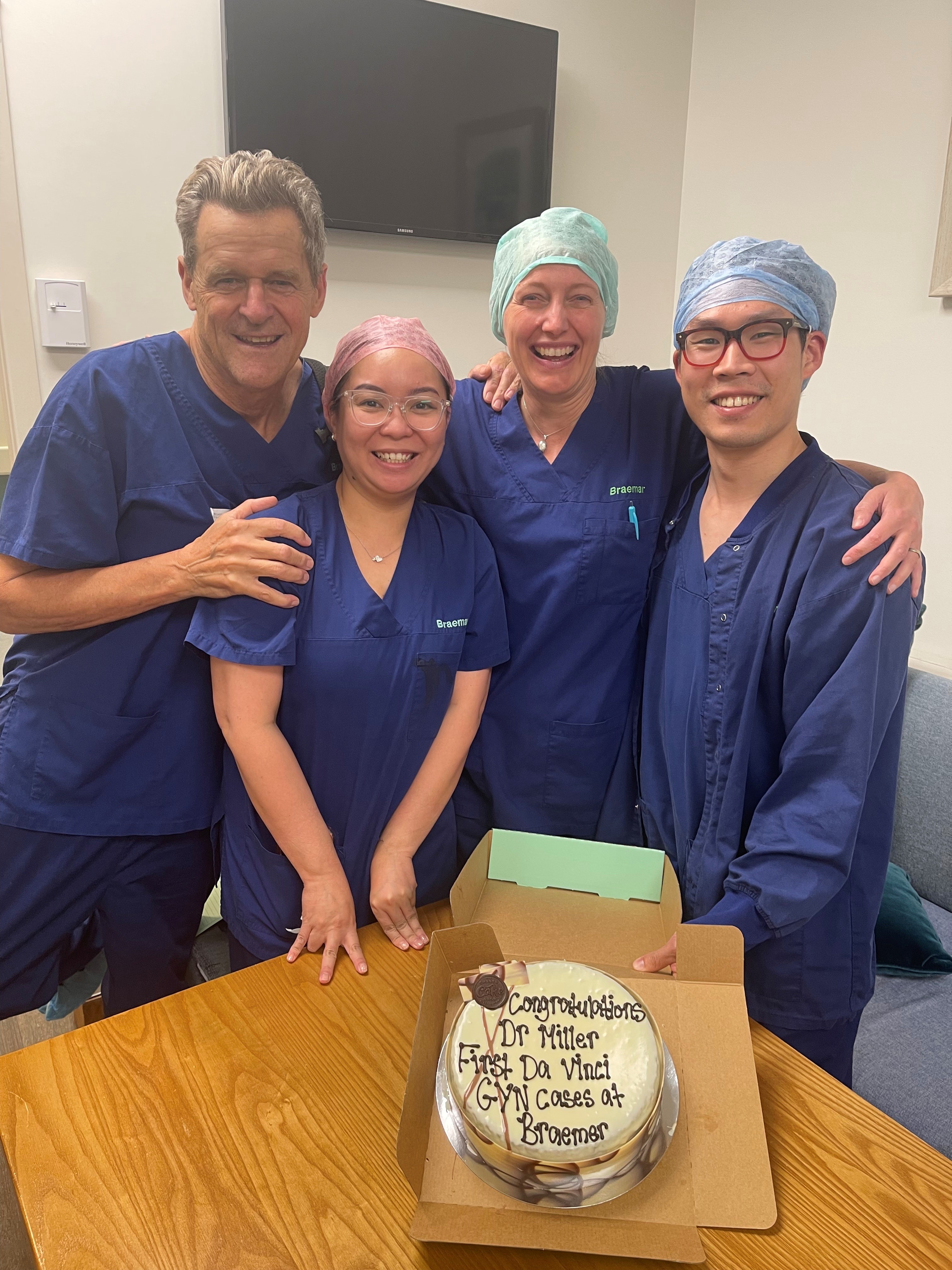
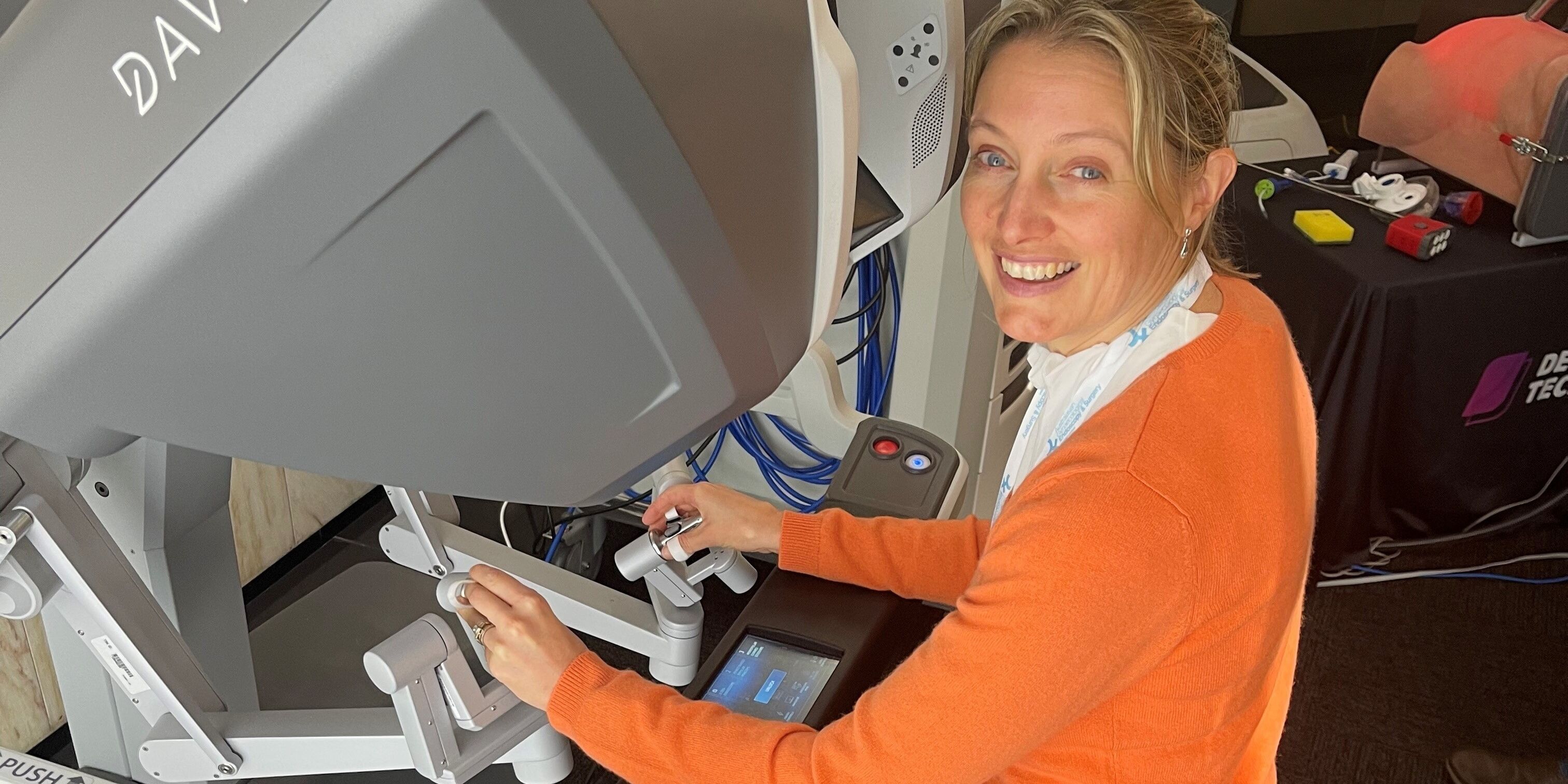
Meet Dr Laura Miller — gynaecologist, mother, and one of Braemar Hospital’s first credentialled surgeons on the da Vinci robot. As International Women’s Day is celebrated this month, she is a passionate champion of a technology she believes is transforming patient care — and she has the sore cheeks to prove it.
“After the first couple of days operating using the robot I had no back ache — but I did have a new muscle that hurt. That was in my cheeks from smiling so much.”
There is a tell-tale sign that Laura Miller has been talking about robotic surgery again. Her cheeks ache.
“My cheeks get sore from smiling so much when I talk about it,” she laughs. It is the kind of unguarded, wholehearted joy that is difficult to manufacture — and in Laura’s case, entirely genuine.
As one of Braemar Hospital’s leading champions of robotic-assisted surgery, Laura Miller is a strong advocate for a technology she believes is fundamentally changing what is possible for patients — and for surgeons. With 21 robotic procedures already completed since her first case in November last year, her conviction is backed by real results.
A First for the Waikato
Braemar Hospital holds the unique position as home to the only da Vinci robotic surgical system in the wider Waikato region. For patients in Hamilton and surrounding areas, this means access to world-class minimally invasive surgery.
For Laura, the arrival of the robot was a moment she had long imagined but never expected.
“At medical conferences over the years I had seen robotics demonstrated and talked about — and I thought to myself, I will never get that chance in New Zealand,” she recalls. “When I heard a robot had come to the Waikato, I drew a breath. I was keen to find out more, and the response from Pru and the team at Braemar was so supportive.”
She wasted no time. Laura contacted Pru Sheahan, Braemar’s Clinical Services Manager, and joined the hospital’s inaugural robotic surgical team. The training — supported by Braemar Hospital and Device Technologies — was intensive, collaborative, and, by all accounts, utterly absorbing.
Her family can attest to that. Her husband and two young sons — aged seven and 10 — laughed that in every spare moment during training, Laura would find a reason to sneak back onto the robot simulator to practice.
Seeing the Difference in Patients
Ask Laura what drives her enthusiasm, and she returns quickly to the same answer: her patients.
“I was surprised how it wasn’t as big of a jump as I thought it would have been. But seeing my patients the next day after procedures — seeing how really good they look — has been wonderful. I am seeing significantly better recovery from patients who have undergone robotic surgery.”
Since performing her first robotic procedure in November last year, Laura has now completed 21 cases — predominantly hysterectomies, along with procedures for endometriosis and adhesions. The improvements she sees, she says, are not incidental: they are built into the technology itself.
“More precision, more control — three instruments and a camera directly under my control which make for better views, vast articulation, and overall more efficient surgery. The ability to do complex procedures with access, precision, and a 3D view is extraordinary. You simply don’t get this level of capability with laparoscopy.”
She also highlights a practical benefit that matters greatly for complex and longer procedures: the robot uses less gas pressure in the abdomen due to patient positioning, and its ergonomic design means surgeons experience none of the physical fatigue associated with traditional laparoscopic work.
“I feel just as fresh in the last procedure of the day as I was at the start,” she says. “No muscle fatigue. Great patient outcomes — but there are also great benefits for surgeons.”
Training the Future
Beyond her own practice, Laura sees Braemar’s da Vinci robot as a transformative resource for the next generation of surgeons in New Zealand.
“I can really see that having a robot in our region for our future trainees and future doctors is going to be incredibly beneficial. The ability to do such intense, accurate training before putting it into action on people is incredible. The demonstrations — the exact feel and view of a procedure — are an advantage you simply don’t get anywhere else.”
She also values the collaborative dimension — the ability to watch recordings of other surgeons’ procedures, share resources and ideas, and continue refining techniques long after initial training is complete. “Once you’re up and running, the technology keeps teaching you,” she says.
A Champion in Every Room
Those who work alongside Laura will tell you that her enthusiasm is not performative — it is contagious. Whether she working alongside colleagues, speaking with a nervous patient, or working with teams in the operating theatre, her energy and depth of knowledge are a constant.
It is a quality that feels fitting as we celebrate International Women’s Day. Laura has been a gynaecologist since 2014, working in a specialty she describes as deeply rewarding — one where the journey with each patient can be long, and the impact of positive outcomes genuinely life-changing.
“It is hugely rewarding being a gynaecologist helping women,” she reflects. “Sometimes the journey is long with a patient, and it is good to know that in many cases we can help change lives for the better.”
And robotic surgery, she believes, is making that possible in ways that were unimaginable just a few years ago — certainly here in the Waikato.
“I just love it. I am so enthusiastic and excited by this — and for the future of surgery.”
The cheeks, she confirms, are still recovering.
Braemar Hospital is home to the only da Vinci robotic surgical system in the wider Waikato region. Dr Laura Miller is one of Braemar’s trained and credentialled robotic surgeons.
Braemar Hospital’s robotic surgery programme continues to grow, offering patients access to minimally invasive procedures across a range of specialties including gynaecology, urology and general surgery. To find out more, visit braemarhospital.co.nz.
“To see Waikato patients gain access to world-class, minimally invasive surgical options in their own region is rewarding and long over due. We are also seeing more specialists embracing this technology – Braemar Hospital is great place to work and I’m keen to hear from any specialists interested in being trained and coming on board with our robotic surgery programme,” says Braemar’s Pru Sheahan, General Manager Clinical Services.
Patients interested in robotic surgery should discuss options with their GP, specialist and insurer. Many health insurance providers cover robotic procedures.
Braemar Hospital is 100% owned by the Braemar Charitable Trust which works to improve healthcare access in the community.